

By Jaspreet Bindra: Economic Times Coverage
Introduction: Every Era Has Its Device
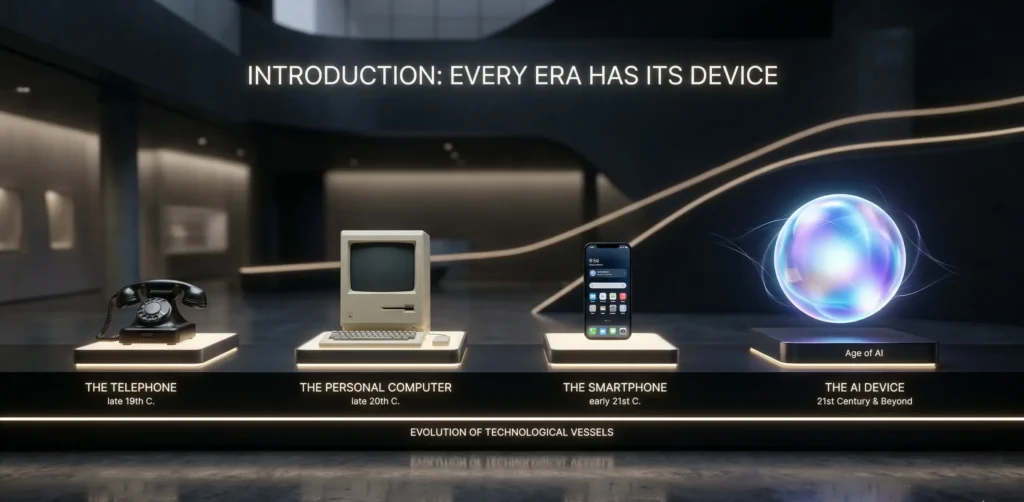
History has a pattern. Every transformative technology age eventually finds its defining physical vessel — the object that puts abstract power into human hands.
The internal combustion engine had the car. Telecommunications gave us the telephone. The information age found its perfect vessel in the personal computer. And the internet age discovered its master device in the smartphone — the most powerful, habit-forming gadget ever created.
Now, as we enter what many are calling the Age of AI, the trillion-dollar question hanging over every boardroom, every venture capital fund, and every technology laboratory is this: What is the defining gadget of the AI era?
The Man Everyone Is Watching: Jony Ive

If there is one designer who has already helped shape a technological era, it is Jony Ive — Apple’s legendary former Chief Design Officer. He was Steve Jobs’ closest creative partner and together they produced era-defining products: the translucent iMac, the revolutionary iPod, and then the most powerful gadget ever created — the iPhone.
In May 2025, OpenAI announced that io, a hardware venture co-founded by Ive, would merge with the company and create a new AI hardware division. OpenAI CEO Sam Altman and Ive framed this not as another gadget launch, but as an attempt to fundamentally rethink humanity’s relationship with computers — at precisely the moment when computers are beginning to “see, think, and understand.”
OpenAI reportedly acquired Ive’s startup io in a deal valued between $6 billion and $6.5 billion, bringing a specialized team of ex-Apple designers and engineers into the OpenAI fold. The goal: to create a new family of products for the AI era. An OpenAI hardware reveal is now anticipated in the second half of 2026, with a full commercial launch potentially arriving in 2027.
The Post-Phone Device: A Graveyard of First Attempts
Ive and Altman have made an audacious promise — they are not building a better phone. They are building the thing after the phone.
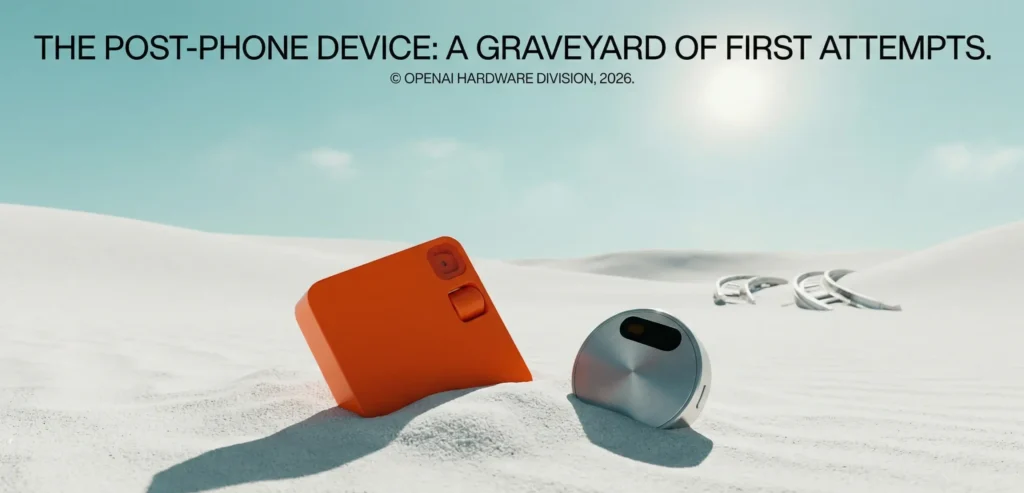
But the market has already witnessed the graveyard of early contenders. Humane’s AI Pin arrived with grand claims of replacing the smartphone and died with poor reviews and weak demand. Rabbit’s r1 generated early excitement and quickly became, as one critic noted, “a pretty orange paperweight.”
The market pressure to find this next device is immense, and so far, the most credible hardware contender remains Meta’s AI glasses, which have slipped AI into an existing, socially acceptable form factor and sold close to 10 million units. Yet, smart glasses remain a specialty gadget rather than a universally acknowledged replacement for the phone — a category device, not a defining one.
The Smartphone Reborn: AI’s Most Surprising Answer
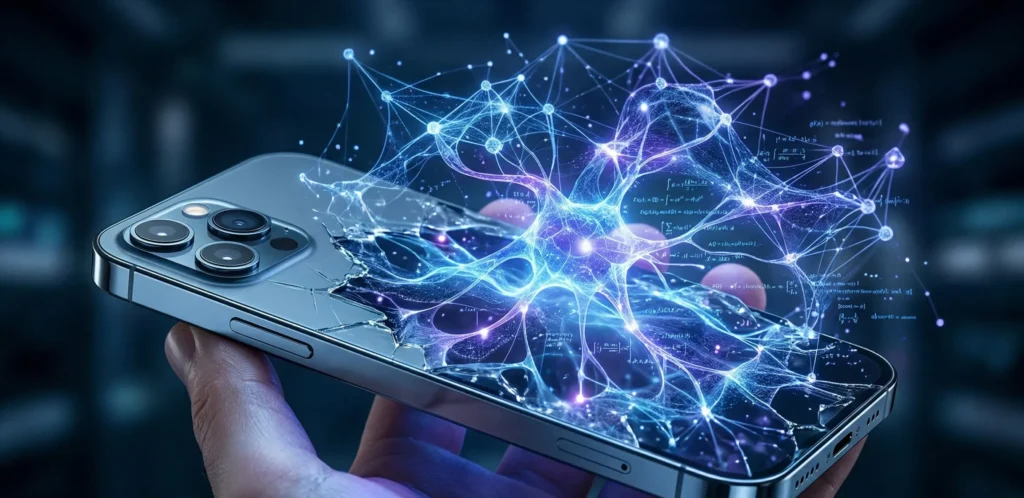
Here is the twist that makes this conversation genuinely fascinating: the defining gadget of the AI era may not be a new object at all.
It may be the smartphone — reborn.
After all, the phone already has everything required: the screen, the microphones, the cameras, the sensors, the chip, the connectivity, and — most critically — our habits. AI does not need to fight for real estate in our lives. It already lives in our pockets.
What changes is the entire technology stack beneath the surface.
Redefining the Stack: The Four Pillars Reimagined
A smartphone today is defined by four pillars: the operating system (iOS/Android), the chip (CPU), the user interface (screen and apps), and the data (what we type or tap). In the AI era, each of these four pillars is being fundamentally redefined.
🔹 LLM as the New OS
In the AI era, you don’t open an app. You tell the system your intent, and the agentic model executes it. Large Language Models (LLMs) become the kernel process of a new operating system — one built around natural language, not menus and icons.
🔹 NPU/GPU as the New Chip
Neural Processing Units (NPUs) designed for lightning-fast inference replace traditional CPUs as the defining hardware component. Real-time AI thought requires a fundamentally different processing architecture.
🔹 Voice as the New UI
Touch UI has dominated human-device interaction for over two decades. As AI becomes more conversational, voice becomes the Zero UI — an interface so natural it barely feels like an interface at all. The next great gadget may not ask you to open an app. It will simply ask: “What do you want done?”
🔹 Ambience as the New Data
The richest stream of human data is not what we type or browse — it is what we say, where we go, who we meet, and the thousands of daily life fragments that never make it onto a screen. The AI gadget of the future will capture gestures, conversations, surroundings, and routines — making ambience the new data layer.
The Privacy Reckoning
This omnipresence comes with serious consequences. The privacy risks are no longer theoretical.
Reports suggest Meta has explored adding facial recognition-style features to its AI glasses, capable of identifying people seen through them. A stranger wearing AI glasses could potentially scrape your LinkedIn profile, home address, and recent bank transactions in real time. Recent reports also indicate that footage captured through Meta’s AI glasses has been reviewed by contractors — raising deeply disturbing questions about intimate surveillance.
As AI devices become more ambient and data-hungry, the tension between personal utility and personal privacy will define the regulatory and ethical battles of the next decade.
The Anti-Phone: What Jony Ive May Actually Build
Reports suggest Ive’s device is targeting a reveal in the second half of 2026. If speculation holds, Ive is not building a better phone — he is building the anti-phone.
Ive has famously lamented the “unintended consequences” of his creation, the iPhone, and how it sucks our time and attention. His AI gadget may be a lesson in minimalism: screenless, tactile, and ambient. Not demanding your attention, but sitting in the background — a silent presence that speaks only when it has something truly meaningful to contribute.
Prototypes reportedly include audio-based designs — wearables like pins or earbuds — where screenless interaction defines the experience. The smartphone era was about the screen. The AI era may be about the presence.
The Irony of the Inventor
There is a beautiful, poignant irony at the heart of this story.
The designer who helped give us the iPhone — the device that made the world look down — may now have to invent the thing that makes us look up again.
Jony Ive doesn’t just need to design the next device. He needs to define the next human habit. If the iPhone was the gadget that made us look down, his creation will be the one that finally makes us look up.
Conclusion: AI Is Waiting for a Body
We are not waiting for artificial intelligence to arrive. AI is already here — in our phones, our browsers, our workplaces, and our creative tools.
What the AI era is still waiting for is a physical form — a device so elegantly suited to the moment that it becomes as inevitable and indispensable as the smartphone once was.
Whether it arrives as the smartphone reborn, as Jony Ive’s ambient anti-phone, or as a device no one has imagined yet — one thing is certain: when the defining gadget of the AI age finally arrives, we will all know it instantly.
Because the best technology always feels less like a tool — and more like a natural extension of what it means to be human.