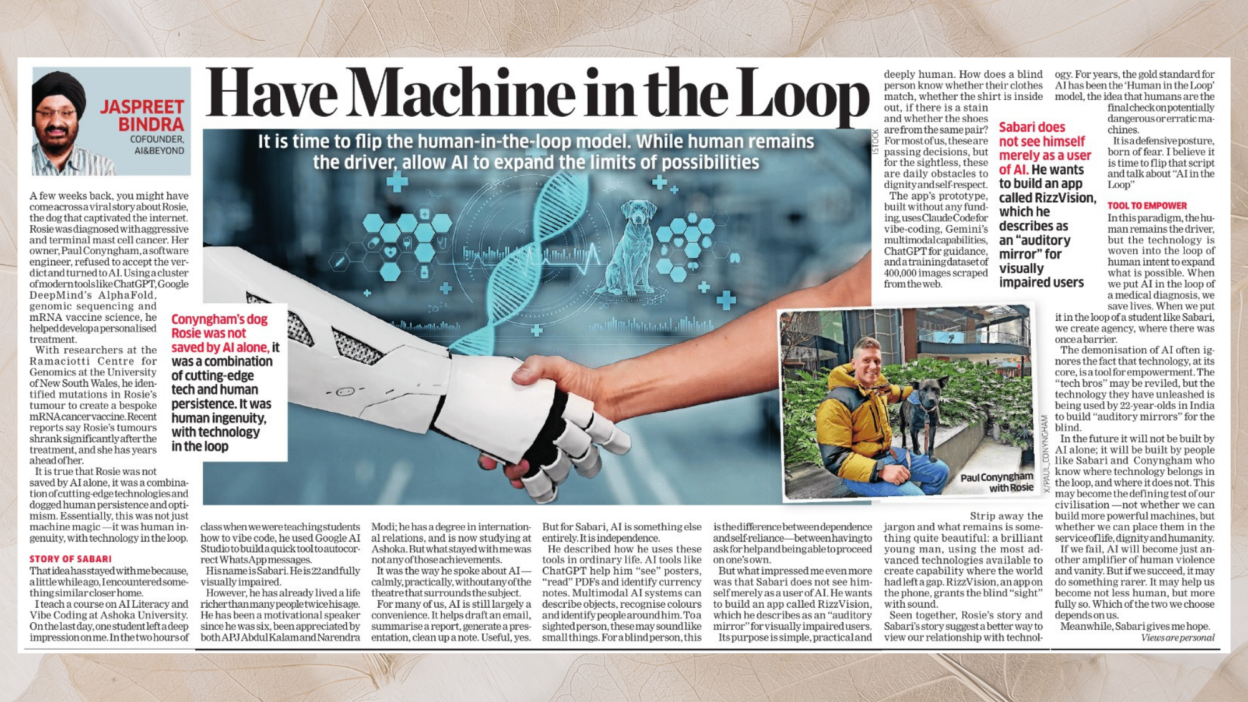
For years, the gold standard of responsible AI has been the “Human in the Loop.” But what if we’ve been looking at it backwards? Jaspreet Bindra, Co-founder of AI&Beyond, makes a compelling case in the Economic Times for why it’s time to put the Machine in the Loop — and let humans lead from a position of expanded power.
The Story That Started It All
It began with a dog named Rosie.
Rosie, owned by Australian software engineer Paul Conyngham, was diagnosed with aggressive and terminal mast cell cancer. The prognosis was bleak. But Conyngham refused to accept it. Instead of surrendering to the verdict, he turned to the most powerful tools available to him — AI.
Using ChatGPT to draft a research plan, Google DeepMind’s AlphaFold to identify mutated proteins in Rosie’s tumour, genomic sequencing, and mRNA vaccine science, Conyngham collaborated with researchers at the University of New South Wales‘ Ramaciotti Centre for Genomics. Together, they developed a bespoke mRNA cancer vaccine — reportedly one of the first personalised cancer vaccines ever designed for a dog. The result? Rosie’s tumours shrank significantly. She has years ahead of her.
Jaspreet Bindra uses this story to make a powerful point: this was not machine magic. This was human ingenuity, with the Machine in the Loop.
What Does “Machine in the Loop” Actually Mean?
For decades, the dominant paradigm in AI safety and deployment has been Human in the Loop — the idea that humans must be the final checkpoint for any potentially dangerous or erratic machine output. It is a defensive posture, and not without merit.
But Bindra argues this framing is born of fear. It positions AI as a threat to be managed rather than a tool to be wielded. The Machine in the Loop model flips this entirely. In this paradigm, the human is still the driver — but AI is woven into the loop of human intent, amplifying what is possible.
“When we put AI in the loop of a medical diagnosis, we save lives. When we put it in the loop of a student like Sabari, we create agency where there was once a barrier,” Bindra writes.
This is the difference between AI as assistant and AI as enabler.
Meet Sabari: The 22-Year-Old Building His Own Vision
The second story Bindra shares is, in many ways, even more striking.
Sabari is 22 years old. He is fully visually impaired. He is a student at Ashoka University, pursuing a degree in International Relations. He has been a motivational speaker since the age of six and has been appreciated by former President APJ Abdul Kalam and Prime Minister Narendra Modi. And he is currently building an app.
The app is called RizzVision. Sabari describes it as an “auditory mirror” for visually impaired users. Its purpose? To answer the deeply human questions that sighted people never have to think about — Do my clothes match? Is my shirt inside out? Are my shoes from the same pair? Is there a stain?
The prototype is being built using Claude Code (Anthropic’s vibe-coding tool), Gemini’s multimodal capabilities for image understanding, ChatGPT for guidance and ideation, and a training dataset of over 400,000 images scraped from the web. Sabari himself learned vibe coding during a class Bindra taught at Ashoka University, where students used Google AI Studio to build tools like auto-correct bots for WhatsApp messages.
For most of us, AI tools — drafting emails, summarising reports, cleaning up notes — are useful conveniences. For Sabari, AI is something entirely different.
It is independence.
The Machine in the Loop Is Not a Threat — It’s a Mirror
Bindra is deliberate in calling out the demonisation of AI. The “tech bros” narrative, he argues, ignores a fundamental truth: technology, at its core, is a tool for empowerment.
Yes, AI can be misused. Yes, it can amplify inequality, disinformation, and harm. But the same technology that draws headlines for its risks is being used by 22-year-olds in India to build auditory mirrors for the blind. It is the same technology that helped a dog owner challenge terminal cancer. In both cases, the Machine in the Loop did not replace human intelligence or human emotion — it expanded it.
The difference between dependence and self-reliance, Bindra reminds us, is the difference between having to ask for help and being able to proceed on one’s own. When AI is placed in the loop of human intent — not as a gatekeeper, but as a co-pilot — it creates capability where the world had left a gap.
Why This Matters for India’s AI Future
India is at a unique inflection point. With a massive youth population, growing digital infrastructure, and an exploding AI literacy movement, the question is not whether AI will reshape lives here — it’s how.
Bindra’s answer is clear: the future will not be built by AI alone. It will be built by people like Sabari and Paul Conyngham — people who understand where technology belongs in the loop, and where it does not. People who use tools like ChatGPT, AlphaFold, Gemini, and Claude Code not as crutches but as accelerators of human will.
The Machine in the Loop model is not about giving up control. It is about expanding the definition of what control can achieve. Strip away the jargon, and what remains is a 22-year-old, blind, brilliantly capable young man, using the most advanced technologies available to him to build something the world needs.
That is the defining test of our civilisation — not whether we can build more powerful machines, but whether we can place them in the service of life, dignity, and humanity.
If we get the Machine in the Loop right, we don’t become less human. We become more fully so.