
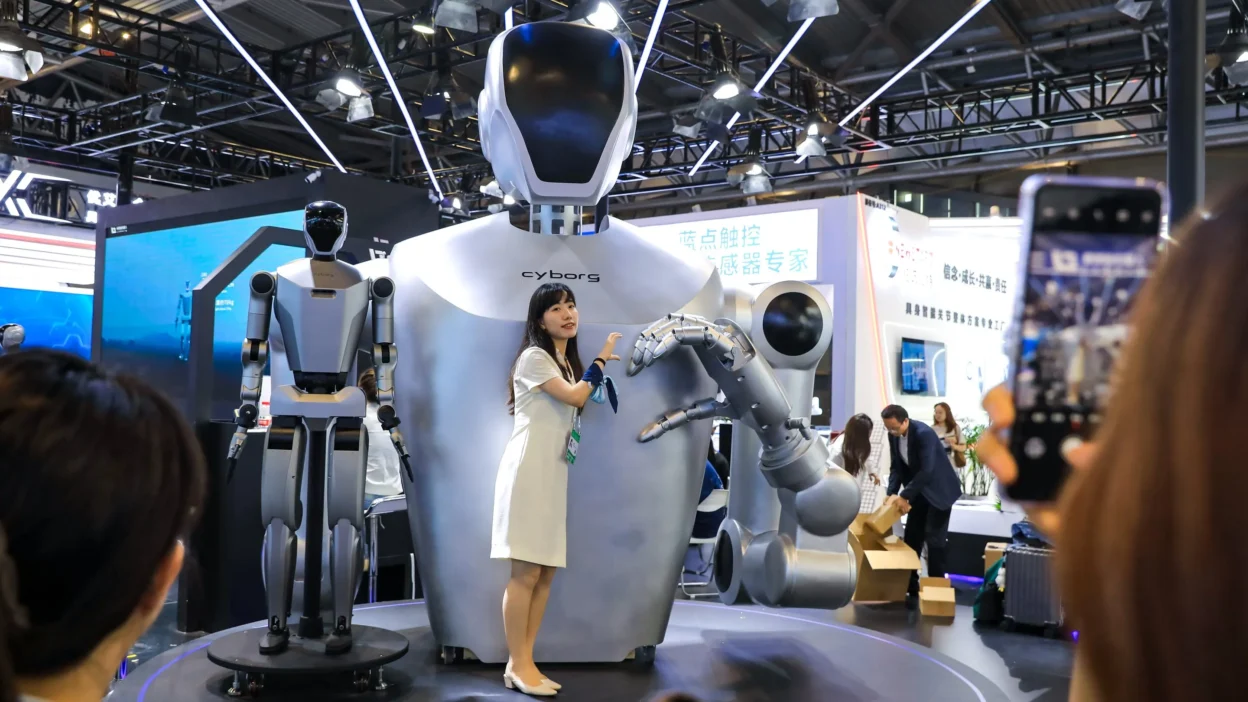
The sight of Chinese families buying humanoid robots — once the stuff of science fiction — is fast becoming an ordinary consumer story in Beijing, Shanghai and Shenzhen. Robots that dance at festivals, tutor children, fetch objects and even perform kung-fu flips are now listed on e-commerce platforms at the price of a premium smartphone. For AI expert and AI&Beyond co-founder Jaspreet Bindra, this is not a quirky retail trend. It is the most visible signal yet of a deliberate, state-backed strategy: Beijing’s billion-dollar bet that the next era of artificial intelligence will be won not on screens, but in the physical world.
From “AI That Talks” to “AI That Acts”: Bindra’s Core Argument
Bindra has a memorable way of framing the AI timeline. If 2024 was the year AI learned to talk, he argues, 2025 was the year it learned to act — the year AI “grew hands.” In his view, the industry’s centre of gravity has shifted from generative AI (chatbots that advise) to agentic and embodied AI (systems that execute). The phenomenon of Chinese families buying humanoid robots sits exactly at this inflection point: intelligence is acquiring a body, and China is making sure that body is manufactured, priced and shipped from its own factories.
He predicts that 2026 is the year “physical AI truly scales” — when robots and autonomous systems move beyond labs and pilots into warehouses, factories, city streets and, increasingly, living rooms. Embodied intelligence, as he puts it, is no longer speculative; it is operational and economically viable.
China’s Quiet Domination: Applications Over AGI Announcements
One of Bindra’s sharpest observations is about how China is competing. While Silicon Valley loudly debates AGI timelines and pours capital into ever-larger language models, he notes that China “quietly dominated” the recent AI cycle by focusing on three unglamorous levers: real-world applications, open-source leadership and energy abundance.
The humanoid robot boom is that philosophy made visible. Consider the numbers behind Beijing’s bet:
China accounted for roughly 85% of the world’s humanoid robot installations last year, according to Barclays estimates, with more than 140 domestic companies selling over 330 robot models. The government’s Humanoid Robot Action Plan, issued by MIIT and five other ministries, targets 100,000 deployed humanoids by 2027. Unitree — now the world’s top humanoid seller — launched its R1 robot at roughly $5,900 and has since pushed prices toward $4,300 on consumer platforms, putting a walking, talking robot within reach of middle-class households. Morgan Stanley projects up to one billion humanoids in use by 2050, a market worth over $5 trillion.
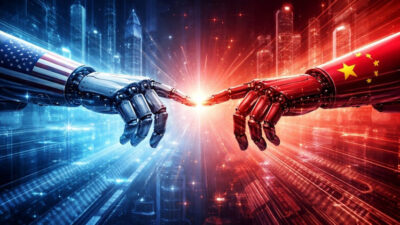
For Bindra, the lesson is that ownership of open source and manufacturing scale is a long-term strategic advantage. America demos; China deploys.
Why Families, Not Just Factories?
So why are Chinese families buying humanoid robots when most units are still, by the makers’ own admission, better at dancing than doing dishes? Bindra’s framework offers three answers.
First, demographics. China faces a rapidly ageing population and rising labour costs. Robots that can eventually assist with eldercare, companionship and household tasks are not a luxury purchase — they are a hedge against a shrinking workforce. Beijing knows this, which is why subsidies flow toward embodied AI rather than chatbots.
Second, cultural normalisation. Every family that buys a humanoid — even as a toy, tutor or status symbol — trains a generation to live comfortably alongside machines. Bindra has long argued that AI adoption is as much a social transition as a technical one. China is effectively running the world’s largest live experiment in human-robot coexistence, and consumer sales are the enrolment mechanism.
Third, the data flywheel. Robots in homes generate exactly the kind of messy, physical-world interaction data that embodied AI needs to improve. Each purchase makes the next generation of robots smarter and cheaper — the same open-source, application-first loop Bindra credits for China’s quiet dominance.
The Caveats: Judgment Over Hype
Bindra is no uncritical cheerleader, and his framing carries a warning. If the last phase of AI was about capability, he insists, the next is about judgment — how we design, deploy and govern these systems. “The age of raw intelligence is behind us. The age of wisdom begins now,” he says.
Applied to humanoids, that scepticism is warranted. Reporting on China’s robot rental market shows machines that still stumble, misidentify objects and require heavy human supervision; over 70% of units sold recently went to research and education buyers, not households doing chores. The gap between viral videos and genuine utility remains wide. Bindra also anticipates a correction in AI valuations — not a collapse, because the technology and cash flows are real, but a repricing of hype. The winners will be companies delivering “invisible, reliable automation that actually works,” not flashy demos.
What It Means for India and the World
Bindra consistently brings the conversation home. If China’s edge is applications, open source and energy, India’s response cannot be to out-spend Silicon Valley — it must be to out-deploy it in areas where India has scale advantages: sovereign AI infrastructure, vernacular AI and affordable robotics for healthcare, agriculture and eldercare. He sees 2026 as a defining moment for India to move from GPU theory to deployment reality.
The image of Chinese families buying humanoid robots, then, is best read the way Bindra reads it: not as a gadget story, but as a geopolitical one. A nation is teaching its citizens, its factories and its algorithms to live in the physical world together — while much of the West is still arguing about chatbots. The question he leaves us with is uncomfortable and clarifying: when intelligence gets a body, who will own the bodies?