
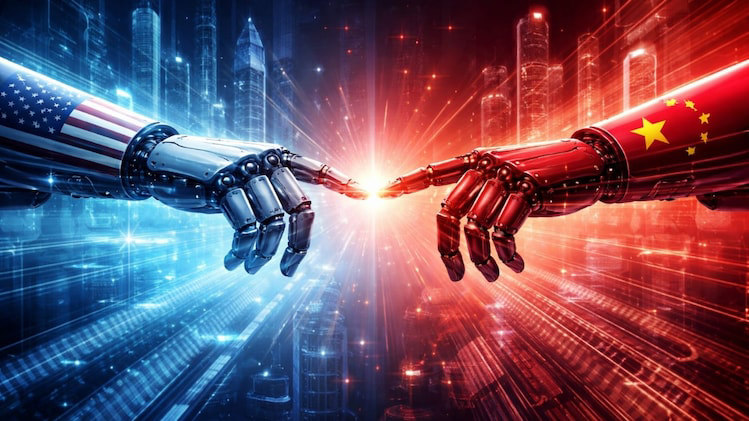
China’s AI models are now within striking distance of their American rivals — on some language benchmarks, the gap has shrunk from 17.5% to a fraction of a percentage point. But for technology thought leader Jaspreet Bindra, Co-founder of AI&Beyond and one of India’s most influential voices on digital transformation, the China–US race is not the story India should obsess over. The real story, in his view, is Indian language AI — whether India can build models that speak, understand, and reason in the 22 official languages and hundreds of dialects its 1.4 billion people actually use. As Chinese AI narrows the gap with the US, Bindra’s message is blunt: India’s language test remains unpassed, and passing it matters more than winning any benchmark war.
The Wake-Up Call: “DeepSeek Is the Best Thing That Happened to India”
When China’s DeepSeek stunned the world with a frontier-class model built at a fraction of Silicon Valley’s cost, most commentators framed it as a US–China story. Bindra flipped the frame entirely.
“DeepSeek is probably the best thing that happened to India,” he said. “It gave us a kick in the backside to stop talking and start doing something.”
That single line captures the core of Bindra’s position. He does not see Chinese AI progress as a threat to be feared but as proof of concept for India: a nation outside Silicon Valley demonstrated that world-class AI can be built with less capital, less compute, and more engineering ingenuity. If China could compress the gap with the US in under three years, India — with its deep engineering talent pool — has no excuse for inaction on Indian language AI.
The provocation worked. Within days of DeepSeek’s launch, India’s Ministry of Electronics and IT opened proposals for sovereign foundation models, mobilised nearly 19,000 GPUs at subsidised rates, and backed startups like Sarvam AI to build a 70-billion-parameter model optimised for Indian languages.
Why the Language Test Is Harder for India Than It Ever Was for China
Bindra’s optimism comes with a clear-eyed acknowledgement of why Indian language AI is a fundamentally harder problem than what the US or China solved.
China trained its models on a massive, largely unified corpus of Mandarin and English data. India has no such luxury. Indian languages collectively account for less than 1% of online content. High-quality, digitised, labelled data in languages like Bhojpuri, Kannada, or Maithili barely exists. Global tokenizers — the systems that break text into units an AI model can process — routinely mangle Indic scripts, misreading characters or skipping them altogether. Complex agglutinative grammar in Hindi, Tamil, and Kannada bloats token counts and degrades model comprehension.
This is India’s “language tax”: the extra cost, in data and compute, of building AI for a country where no single language is spoken by a majority. Chinese AI never had to pay it. American AI never had to pay it. Indian language AI cannot avoid it — which is precisely why Bindra frames it as India’s defining test rather than a side quest.
The Prize: Educating Hundreds of Millions Through Conversation
What makes Bindra’s point of view distinctive is that he treats the language problem not as a burden but as India’s largest addressable opportunity. His most-quoted line on the subject makes the stakes concrete:
“If it becomes part of the India stack, you can educate hundreds of millions through conversational interfaces.”
This is the heart of his argument. India’s digital public infrastructure — Aadhaar, UPI, DigiLocker — transformed identity and payments at population scale. Bindra believes Indian language AI is the natural next layer of that stack. A farmer in Bihar asking about crop insurance in Bhojpuri, a student in Madurai learning physics in Tamil, a first-time entrepreneur in Indore navigating GST in Hindi — voice-first, vernacular AI turns every smartphone into a teacher, a lawyer, and a bank clerk. For a country where English fluency is a minority privilege, that is not a feature. It is the entire point.
In other words, while China measures success against US benchmarks, Bindra measures Indian success against Indian realities: inclusion, access, and education at a scale no other democracy has attempted.
2026: The Defining Moment for Indian Language AI
Bindra is equally specific about timing. Looking ahead, he has called 2026 “a defining moment” for India, predicting “progress in sovereign AI infrastructure, an explosion of vernacular content, and GPU access that finally feels real rather than theoretical.”
Each phrase is deliberate. Sovereign AI infrastructure means India owning its model layer rather than renting intelligence from American or Chinese labs. An explosion of vernacular content directly attacks the data scarcity that has held Indian language AI back. And “GPU access that finally feels real” acknowledges the compute bottleneck that has forced Indian startups to innovate frugally — the IndiaAI Mission’s 18,000+ GPUs are finally changing that equation.
He also draws a strategic lesson from China’s playbook: China won ground not by proclaiming AGI timelines, but through applications, open-source leadership, and energy abundance. Ownership of open source, Bindra notes, proved to be a long-term strategic advantage — a pointed observation for India, where the debate over whether publicly funded models like Sarvam’s should be open-source is still unresolved.
The Bottom Line: Stop Spectating, Start Building
Strip away the benchmarks and Bindra’s POV reduces to three convictions. First, Chinese AI closing the gap with the US is a motivational gift to India, not a menace. Second, India’s true test is not matching GPT or DeepSeek on English-language leaderboards but cracking Indian language AI for a billion non-English speakers. Third, the window is now — with government compute, startup energy, and political will finally aligned, 2026 is India’s moment to convert talk into models.
The China–US race will dominate headlines. But if Bindra is right, the more consequential race is the one India runs against its own linguistic complexity. Winning it wouldn’t just give India a model of its own — it would give hundreds of millions of Indians their first real conversation with the intelligence age, in their own mother tongue.