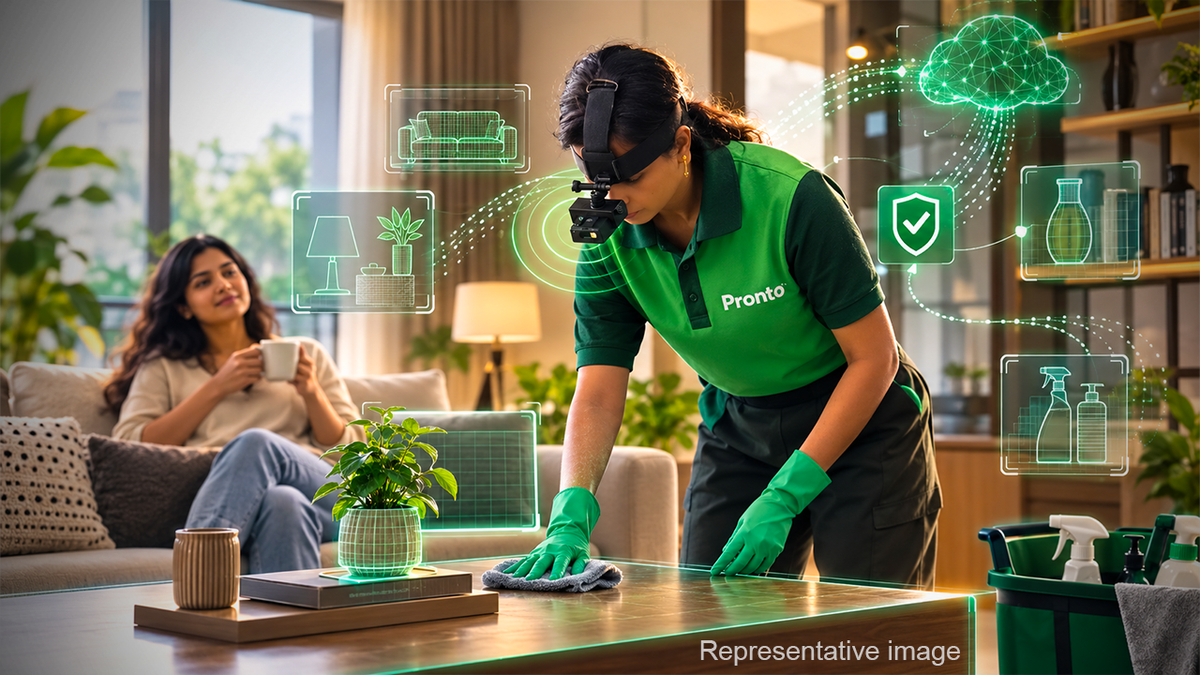
The launch of Pronto wearable cameras for AI training has become one of India’s most talked-about technology stories of 2026, and few voices have cut through the noise as clearly as AI expert Jaspreet Bindra. When Pronto, the Bengaluru-based home-services startup, rolled out a premium “verified” service that puts head-mounted cameras on domestic workers to capture household chores as real-world data, it opened a debate that reaches far beyond one company. For Bindra — who holds a Master’s in AI, Ethics & Society from the University of Cambridge and writes on technology for leading Indian publications — the story of Pronto wearable cameras for AI training is a case study in how India will, or won’t, build “physical AI” responsibly.
What Pronto Actually Launched
Pronto’s premium verified tier lets customers opt in to have their household jobs — cleaning, folding laundry, washing dishes, organising kitchens — recorded by outward-facing cameras worn by service professionals. The company says the pilot covers a tiny slice of bookings, that no audio is captured, that footage is anonymised and deleted within 48 hours, and that customers must actively consent before every recorded visit.
The controversy ignited when investor documents surfaced linking these workflows to “physical AI” and robotics training. In plain terms, the mundane motions of running a home — how hands grip a cloth, how a body bends to reach a shelf — are exactly the “real-world training data” that robotics labs need to teach machines to operate in human spaces.
Pronto also confirmed it retains “derived datasets,” including key-point mapping that tracks body joints and hand movements, and declined to say whether those datasets could be monetised or shared with third parties. That gap between “deleted in 48 hours” and “kept as derived data” is where the Pronto wearable cameras for AI training debate gets uncomfortable.
Jaspreet Bindra’s Point of View
Bindra’s perspective on Pronto wearable cameras for AI training is neither reflexively anti-innovation nor dismissive of privacy fears. As an AI-ethics specialist, his framing tends to hold two truths at once: that physical AI is a genuine frontier India should compete in, and that competing on the backs of unclear consent and invisible data flows is a poor foundation to build on. His key points on the topic can be understood along the following lines.
1. Consent must be specific, not buried. Bindra’s consistent position on data ethics is that agreeing to one thing is not agreeing to everything. A customer who consents to a cleaning service — even a “recorded” one — has not necessarily consented to their home becoming perpetual training material for commercial robotics models. For consent to be meaningful, people must understand exactly what is captured, what is derived, how long it survives, and who ultimately benefits. On Pronto wearable cameras for AI training, the vagueness around “derived datasets” is precisely the kind of ambiguity he flags as a red line.
2. Data dignity is the real issue, not just privacy. Bindra often reframes these debates from “privacy” to “data dignity” — the idea that people whose lives generate valuable data deserve transparency, agency, and often a share of the value. The domestic workers wearing the cameras and the households being filmed are, in effect, an unpaid data-labour force powering someone else’s AI roadmap. His POV pushes companies to ask who is extracting value and whether the people supplying it are treated as partners or as raw material.
3. Innovation and responsibility are not opposites. A recurring theme in Bindra’s writing is that India does not have to choose between building ambitious AI and protecting citizens. Physical AI, embodied robotics, and real-world datasets are legitimately important — India has an opportunity to lead rather than merely consume this technology. But he argues that responsible design, clear governance, and trust are competitive advantages, not compliance costs. Pronto wearable cameras for AI training could have been a showcase for ethical data collection; instead it became a cautionary tale because the guardrails were unclear.
4. Regulation and self-governance both matter. With the story drawing scrutiny from India’s IT ministry and comparisons to how rivals like Urban Company distanced themselves, Bindra’s view is that the sector cannot wait passively for law to catch up. The Digital Personal Data Protection framework sets a direction, but companies building physical AI need their own robust standards — purpose limitation, data minimisation, auditable deletion, and honest disclosure — before public trust erodes to the point where regulation becomes punitive.
5. Trust is the scarcest resource in AI. Ultimately, Bindra’s throughline is that AI adoption in India depends on trust, and trust is easy to spend and hard to rebuild. When a household cannot be sure whether footage of its private life is truly gone or quietly living on as a “derived dataset,” the damage extends beyond one brand to the entire category of AI-enabled services.
Why His POV Matters
What makes Bindra’s take on Pronto wearable cameras for AI training valuable is that it moves the conversation past outrage. He acknowledges the strategic prize — India generating the physical-world data that global robotics needs — while insisting that the how is non-negotiable. His message to founders is blunt in spirit: you can build the future of physical AI, but do it with informed consent, data dignity, and transparency baked in from day one, not bolted on after the backlash.
For businesses watching this unfold, the lesson is practical. Design consent flows that a real person can understand. Be honest about derived data. Give the people generating value a stake in it. Treat trust as a product feature. That, in Bindra’s reading, is how India turns the Pronto moment from a privacy scandal into a template for building physical AI the right way.
The debate over Pronto wearable cameras for AI training is far from settled — but thanks to voices like Jaspreet Bindra’s, it is at least being had on the right terms: not “innovation versus privacy,” but how to have both.