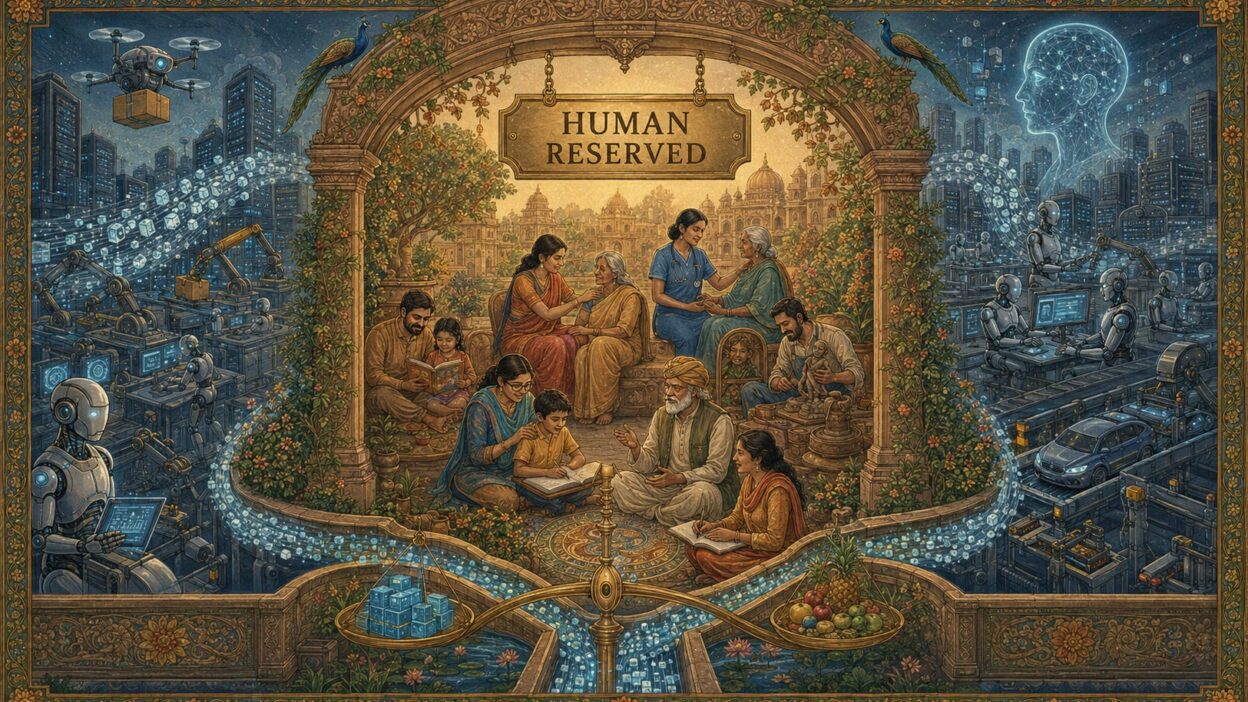
India has argued about reservation for more than seventy years. Now Bill Gates has proposed a reservation system for an entire species, and he calls it “Human Reserved.” Writing in his Sunday Times of India column, technology thinker Jaspreet Bindra — founder of AI&Beyond and author of Winning With AI: Your Guide to AI Literacy — argues that the idea of Human Reserved jobs is the most provocative policy proposal to come out of the AI debate so far, precisely because it forces a question no country has answered: which parts of the economy do we deliberately choose to keep human?
Why Bindra says Gates deserves a hearing
Bindra opens with a separation most commentators refuse to make. Whatever one makes of the controversies around Bill Gates’ personal reputation, he writes, “his record as a technology forecaster deserves to be judged separately.”
The evidence he offers is specific. Microsoft was built around the audacious vision of a computer on every desk and in every home. Gates’ 1995 book The Road Ahead imagined pocket computers, digital commerce, video on demand, conversational speech interfaces and intelligent software agents. Some predictions arrived late. A surprising number arrived. And in 2023, Gates argued that AI agents would become the next great computing platform — a prediction that looks considerably less futuristic today than it did then.
That track record is why Bindra believes the latest 6,000-word Gates Notes essay, which reportedly suggests as much as 40% of jobs could initially be ring-fenced for people, is worth taking seriously rather than dismissing as billionaire philosophy.
The reservation analogy is imperfect — and that is the point
Bindra’s most original contribution is to place Human Reserved jobs inside India’s lived experience of affirmative action rather than treating it as a purely Western thought experiment.
He notes that reservation is not an Indian peculiarity. Brazil introduced racial quotas, Malaysia has Bumiputera preferences, and South Africa built policies to redress the legacy of apartheid. America developed its own version through affirmative action.
Then he does something unusual for an opinion column: he reports the evidence honestly on both sides. Studies of Indian engineering college reservations found that disadvantaged entrants received significant economic benefits and were genuinely poorer than the candidates they displaced. In America, research has found that affirmative action can narrow racial gaps, while bans have sometimes reduced college completion and earnings among underrepresented groups.
His verdict is deliberately unromantic: “Reservation, in other words, has been neither the miracle its supporters sometimes claim nor the disaster its critics portray. It has been an imperfect instrument for compensating for structural disadvantage.”
That framing matters, because Bindra’s next move is to scale it up. AI, he argues, may create structural disadvantage on an altogether larger scale — humans competing against something that can work continuously, learn rapidly, reproduce almost infinitely, and become cheaper every year. “Perhaps the next affirmative-action category is simply Homo sapiens.”
From muscle, to brain, to heart
The cleanest line in the piece is Bindra’s three-era framing of work: industrial-age jobs were about muscle, the digital age was about the brain, and the AI age may be about the heart.
He draws this from Gates’ own example — the caregivers who looked after his father during Alzheimer’s. They understood needs he could no longer articulate. A robot might eventually perform every physical action involved in that care, but something essential would still be missing. Gates asks a second question in the same spirit: should anyone receive news of a terminal illness from a machine simply because the machine can deliver it efficiently?
What a Human Reserved list would actually contain
From that logic, Bindra sketches the occupations most likely to qualify: eldercare, childcare, nursing, mental-health counselling, teaching, mentoring, coaching, social work, parts of medicine, spiritual guidance and perhaps even leadership.
His formulation is the one worth quoting: in these roles, “empathy, trust, presence, and human connection are not incidental to the service. They are the service.”
The questions nobody has answered
Bindra is careful not to oversell the idea. Gates openly admits he does not know how such a system would work, and Bindra says plainly that neither does he.
The unresolved questions he raises are the practical heart of the column:
- Who decides which jobs qualify? Parliament, regulators, employers, or the workers themselves?
- Can a hospital be compelled to employ a human nurse when an AI-enabled robot costs one-tenth as much?
- Would different countries reserve different occupations, creating a competitive race to the bottom?
- Would we end up with two labour markets — one relentlessly automated and productive, the other deliberately human and less efficient?
- And who pays for the inefficiency?
Taxing tokens, not just robots
Here Bindra revives an idea for which Gates was ridiculed almost a decade ago. In 2017, Gates proposed taxing robots that replace human workers. Today he goes further: tax robots and even AI tokens, the basic units of AI consumption.
Bindra finds the logic compelling. Governments currently tax human labour. If companies replace that labour with machines, tax revenues disappear precisely when governments need more money for retraining and social support. A token tax could become, in effect, the mechanism through which machine productivity subsidises human work.
Beyond UBI: the purpose problem
The final argument is the one most commentators miss. The usual answer to technological unemployment is Universal Basic Income, or in a sufficiently abundant AI economy, Universal High Income.
Bindra’s objection is not economic but human. People do not work only for money. Jobs provide status, community, structure, achievement and, for many, a large part of identity and purpose. As he puts it, “a society in which millions are economically comfortable but feel economically unnecessary may not be a particularly happy one.”
Bindra’s closing verdict
His conclusion reframes the entire debate. For decades, the argument about reservation has essentially been about which humans deserve protection from historical disadvantage. AI may force a far stranger debate.
“The question may no longer be which jobs should be reserved for which humans,” Bindra writes, “but which parts of the economy we choose to reserve for humanity itself.”
Whether or not Human Reserved jobs ever become policy, that is the question leaders, regulators and business owners will have to answer this decade.
Bindra’s Key Points at a Glance
- Judge Gates the forecaster separately from Gates the public figure — the prediction record earns a hearing.
- Reservation is a global instrument, not an Indian quirk, and the evidence on it is genuinely mixed.
- Reservation has been neither miracle nor disaster — an imperfect fix for structural disadvantage.
- AI creates structural disadvantage at species scale; the next affirmative-action category may be Homo sapiens.
- Work moved from muscle to brain; the AI age may be about the heart.
- In care, teaching and counselling, empathy is not incidental to the service — it is the service.
- Nobody has answered who decides which jobs qualify, or who pays for the inefficiency.
- Taxing AI tokens and robots could make machine productivity subsidise human work.
- UBI solves income, not identity — economically comfortable but economically unnecessary is not a happy society.
- The real question: not which humans get reserved jobs, but which parts of the economy we reserve for humanity.