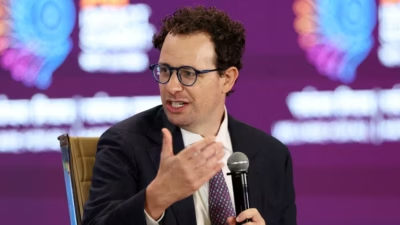
The 1980s AI photo trend is all over Instagram, WhatsApp and LinkedIn. People are turning ordinary selfies into film-grain portraits with big hair, neon backdrops and shoulder pads. It’s fun, it takes seconds, and it seems free. But the energy behind each image is real, and it’s bigger than most people assume. As the trend grew, several technology leaders were asked what one retro AI image actually costs. One of them was Jaspreet Bindra, founder of AI&Beyond and author of The Tech Whisperer. His answer is short, but it says a lot about how we should think about everyday AI.
What is the 1980s AI photo trend?
You upload a photo to a generative AI image tool and ask it to restyle you as if the picture were taken in the 1980s. The tool rebuilds the whole image: the lighting, the grain, the clothes and the background. That’s why the results look so convincing. It’s also why the 1980s AI photo trend uses much more computing power than a filter or a text chat.
Jaspreet Bindra’s POV: 0.1 to 4 watt-hours per image
Bindra estimates that one AI-generated image uses between 0.1 and 4 watt-hours of electricity. What matters most is the width of that range. The top of it is 40 times the bottom. He says three things decide where a given image falls:
- Model size. Bigger image models with more parameters need more computation for every image. A lightweight model and a frontier model can produce similar-looking selfies at very different energy costs.
- Hardware. The same model uses different amounts of power on different chips. Newer data-centre GPUs do more work per watt than older ones.
- Workload. Resolution, the number of refinement steps and how busy the servers are all change the cost. Every “regenerate” click counts as another image.
The point is that “how much energy does an AI image use?” has no single answer. It depends on the model, the hardware and how people use the tool. That makes the cost something companies can manage through design choices, not a fixed number to shrug at.
What 4 watt-hours looks like
- 0.1 Wh runs a 10-watt LED bulb for about 36 seconds.
- 4 Wh runs the same bulb for about 24 minutes, or equals roughly a fifth of a full smartphone charge.
For one selfie, that’s small. The trend isn’t one selfie, though.
From one selfie to millions
This is where the environmental cost of AI images starts to matter. One estimate puts global AI image generation at about 80 million images a day in 2026 (Colombia One). Apply Bindra’s range to that volume:
- At 0.1 Wh per image: about 8 megawatt-hours a day
- At 4 Wh per image: about 320 megawatt-hours a day
That’s a 40-fold gap across the whole industry. The model, hardware and workload choices Bindra points to are the difference between a small footprint and a serious one.
The wider picture points the same way. The International Energy Agency projects data-centre electricity use will nearly double to about 945 TWh by 2030. Research cited by the UN University says 80–90% of AI’s energy use comes from inference, meaning the everyday work of answering prompts and making images, not the one-time training of models (Trak.in). Viral trends like this one are inference at huge scale.
The water behind your retro selfie
Electricity isn’t the only cost. The UN University puts the water footprint of one AI image at about 29 millilitres, roughly two tablespoons, mostly from cooling data centres and generating power. A study in Water Research projects AI’s global water footprint could reach 4.2 to 6.6 billion cubic metres a year by 2027. So the AI water footprint of a viral trend is measured in reservoirs, not tablespoons.
Other experts agree with Bindra’s view
Bindra wasn’t alone. Dr. Srinivas Padmanabhuni, CTO of AiEnsured, estimated about 1.2 watt-hours per image, which sits inside Bindra’s range. Ritvik Batabyal, CTO of Mastech Group, also said the cost depends on the model and how it’s deployed. He added that easy digital creation shouldn’t be mistaken for zero physical cost, and called for efficiency gains across the whole AI stack.
All three agree that the cost per image is modest but not zero, and that it depends heavily on the model, the hardware and how the tool is used.
What this means for users, brands and AI builders
Taking Bindra’s three factors as a starting point:
- Users: You don’t need to stop joining the trend. Just be deliberate. Five regenerations cost five images. Choose your best prompt instead of rerolling again and again.
- Brands running AI campaigns: A viral “make your AI avatar” campaign can generate millions of images. Choosing the model and resolution is a sustainability decision as well as a creative one.
- AI platforms: Sending simple style-transfer requests to smaller, efficient models on modern hardware could cut costs at scale. That’s the lever the 40x range points to.
This fits the idea at the heart of Bindra’s AI literacy work: using AI well includes understanding what it costs, not only what it can do.
FAQs
How much electricity does one AI image use?
Jaspreet Bindra estimates 0.1 to 4 watt-hours, depending on model size, hardware and workload. Other estimates, such as about 1.2 Wh from AiEnsured’s CTO, fall within that range.
How much water does the 1980s AI photo trend use per image?
The UN University estimates about 29 ml per AI image, linked to data-centre cooling and power generation.
Is the 1980s AI photo trend bad for the environment?
One image has a small footprint. The problem is scale: tens of millions of images a day, plus repeated regenerations, add up to real electricity and water demand.
Can AI image generation become more sustainable?
Yes. Smaller models, more efficient chips and fewer unnecessary regenerations can all lower the energy per image. That’s why the wide range Bindra describes matters.
Conclusion
The 1980s AI photo trend is a harmless bit of nostalgia at the level of one person. Jaspreet Bindra’s 0.1 to 4 watt-hour estimate is a reminder that every AI image runs on real electricity, water and hardware. How much it uses is set by choices about models, chips and workloads. Enjoy the trend, but know what it costs.