
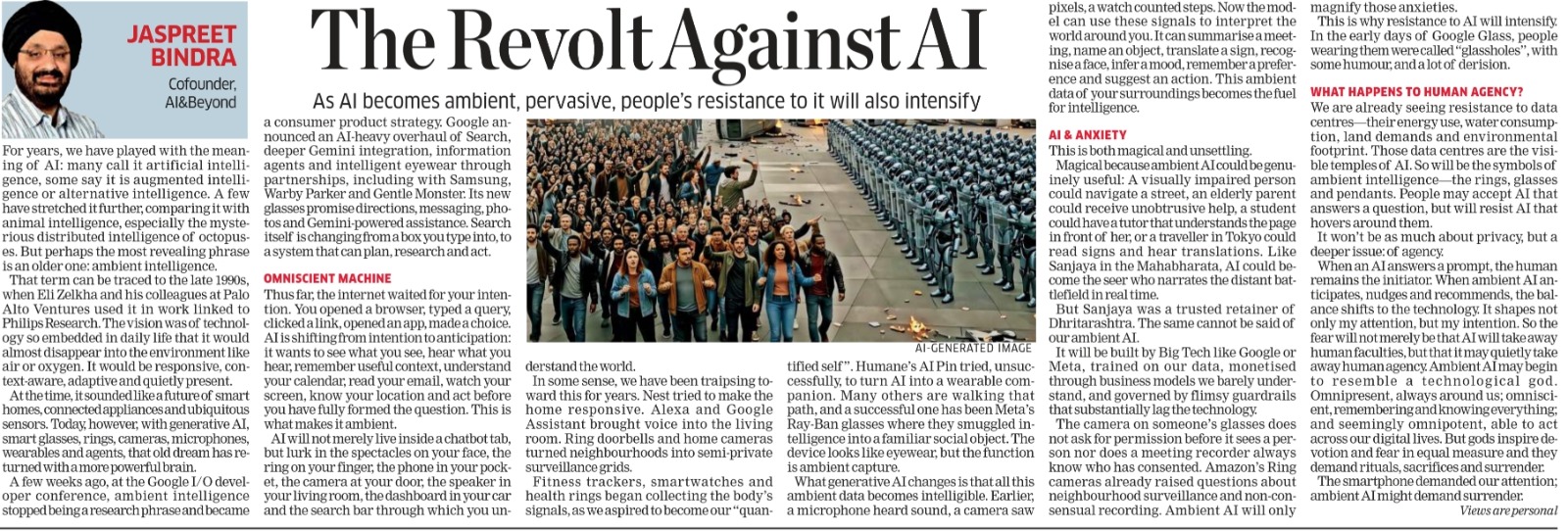
In his Economic Times essay “The Revolt Against AI,” technology thinker Jaspreet Bindra makes a striking prediction: the more invisible and pervasive ambient AI becomes, the harder people will push back against it. As Bindra frames it, the deepest fear isn’t that machines will outsmart us, but that ambient AI will quietly take over the one thing we most want to keep for ourselves: our agency. This article unpacks his perspective, his core arguments, and why he believes resistance to AI is set to intensify rather than fade.
The most revealing phrase: ambient intelligence
Bindra begins with a word we rarely use but should: ambient. He traces “ambient intelligence” back to the late 1990s, when Eli Zelkha and colleagues at Palo Alto Ventures coined it alongside Philips Research. The vision was technology so embedded in daily life that it would “almost disappear into the environment like air or oxygen” — responsive, context-aware, and quietly present.
For years this sounded like a distant dream of smart homes and ubiquitous sensors. But with generative AI, smart glasses, rings, cameras, microphones, wearables and agents, Bindra argues that the old dream has returned with far more power. Ambient AI is no longer a research phrase; at Google’s I/O developer conference it became a full-blown consumer product strategy, complete with an AI-heavy overhaul of Search, deeper Gemini integration, and intelligent eyewear built with partners like Samsung, Warby Parker and Gentle Monster.
From intention to anticipation
The heart of Bindra’s argument is a shift he describes vividly. For decades, the internet waited for your intention. You opened a browser, typed a query, clicked a link, made a choice. Ambient AI flips that relationship. Instead of waiting, it anticipates. In Bindra’s words, it wants to “see what you see, hear what you hear,” read your email, watch your screen, know your location, and act before you have fully formed the question.
This is why he insists AI will not stay politely inside a chatbot tab. It will live in the spectacles on your face, the ring on your finger, the phone in your pocket, the camera at your door, the speaker in your living room, and the dashboard in your car. Fitness trackers, smartwatches and health rings already harvest the body’s signals as we chase the “quantified self.” What changes with generative AI, Bindra notes, is that all this ambient data suddenly becomes intelligible — a model can summarise a meeting, name an object, translate a sign, recognise a face, infer a mood, and suggest an action. The data of your surroundings becomes the fuel for intelligence.
Magical and unsettling at once
Bindra is careful not to be a doom-monger. He acknowledges that ambient AI can be genuinely magical. A visually impaired person could navigate a street, an elderly parent could receive unobtrusive help, a student could get a tutor who understands the page in front of her, and a traveller in Tokyo could read signs and hear translations in real time.
He reaches for a memorable metaphor from the Mahabharata: ambient AI could become like Sanjaya, the seer who narrated the distant battlefield to the blind king Dhritarashtra in real time. But here lies the catch. Sanjaya was a trusted retainer. The same, Bindra warns, cannot be said of our ambient AI. It will be built by Big Tech like Google and Meta, trained on our data, monetised through business models we barely understand, and governed by what he calls flimsy guardrails that substantially lag the technology.
The consent problem and a coming backlash
A recurring concern in Bindra’s view is consent. A camera on someone’s glasses does not ask permission before it sees a person. A meeting recorder does not always know who has consented. He points to how Amazon’s Ring cameras already raised hard questions about neighbourhood surveillance and non-consensual recording — and argues that ambient AI will only magnify those anxieties.
That, he says, is why resistance will intensify. He recalls that in the early days of Google Glass, the people wearing them were mockingly called “glassholes,” with humour and a fair amount of derision. The visible symbols of ambient intelligence — the rings, glasses and pendants — risk becoming the next lightning rods. People may happily accept AI that answers a question, but resist AI that simply hovers around them.
The real issue: human agency, not privacy
Here Bindra makes his sharpest distinction. He connects the backlash against ambient AI to the existing resistance against data centres, which he calls the visible “temples” of AI, already contested over their energy use, water consumption, land demands and environmental footprint. The wearables of ambient intelligence, he predicts, will become similar symbols of unease.
But the deeper issue, he argues, is not privacy — it is agency. When an AI answers a prompt, the human remains the initiator. When ambient AI anticipates, nudges and recommends, it shifts the balance. It shapes not only our attention but our intention. The fear, Bindra writes, is not that AI will take away human faculties, but that it may “quietly take away human agency.” We will still feel free while increasingly being steered.
A technological god that demands surrender
Bindra ends with a powerful image. Ambient AI, he suggests, may begin to resemble a technological god — omnipresent, omniscient and seemingly omnipotent, always around us, remembering and knowing everything across our digital lives. And gods, he reminds us, inspire devotion and fear in equal measure; they demand rituals, sacrifices and surrender.
His closing contrast is the line that captures the whole essay: the smartphone demanded our attention; ambient AI might demand our surrender. We fear AI, in his telling, not because we are handing over our intentions, but because we are handing over our agency.
The takeaway
Jaspreet Bindra’s “Revolt Against AI” is not a rejection of the technology’s benefits. It is a warning that as AI becomes ambient, pervasive and anticipatory, human resistance is a natural and even healthy response. The question he leaves with leaders, builders and regulators is whether ambient AI can be designed to preserve human agency — to remain a tool we direct, rather than a presence that quietly directs us.