
The Meta-CRED deal has quietly become one of the most consequential tech stories involving India’s startup ecosystem in years, and few have read it as sharply as Jaspreet Bindra, founder-MD of The Tech Whisperer. Writing in The Economic Times, Bindra argues that Meta’s $900 million investment in CRED is far more than a fintech bet. It is, in his view, Meta’s tacit admission that the future of WhatsApp may not be invented in Menlo Park at all, but in India’s maidan, one transaction at a time.
This piece unpacks the Meta-CRED deal through Bindra’s lens, his read on Kunal Shah as a “consumer anthropologist,” the opportunity it opens for India, and the “data colonialism” shadow he warns hangs over it.
What the Meta-CRED deal actually says
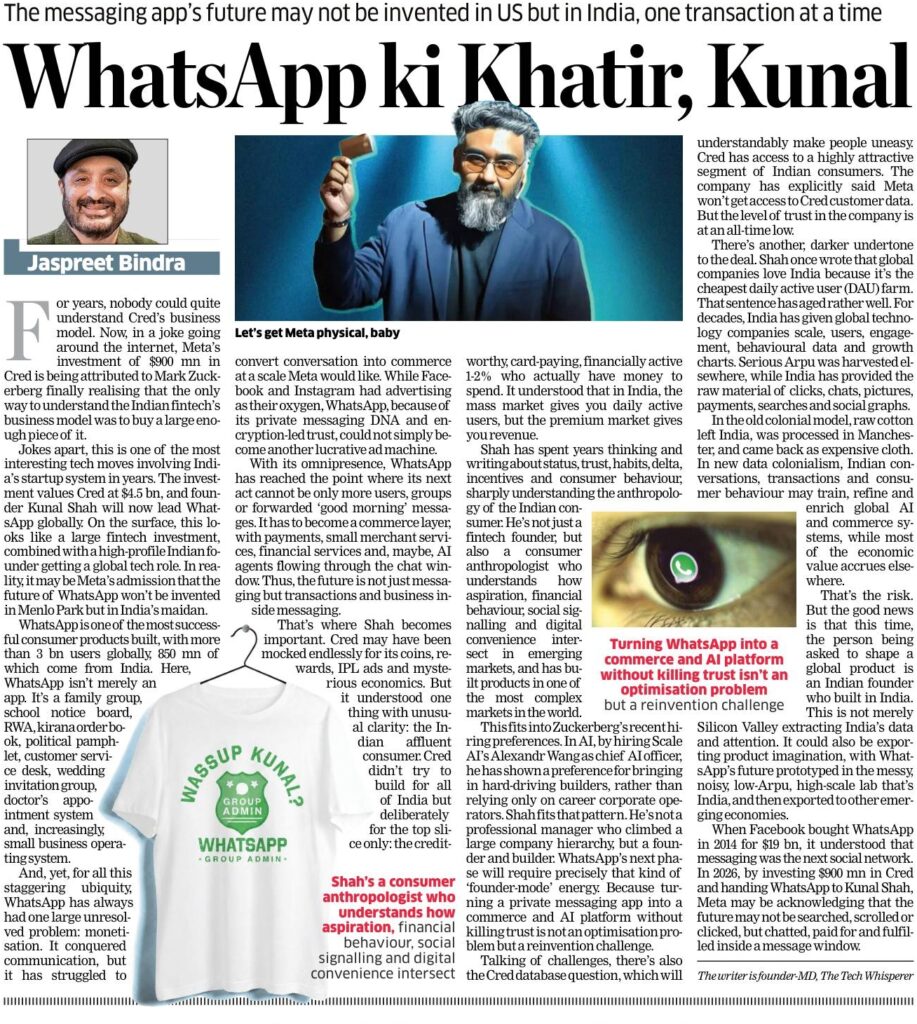
On the surface, Bindra notes, the Meta-CRED deal looks like two familiar headlines stitched together: a large fintech investment that values CRED at $4.5 billion, and a high-profile Indian founder, Kunal Shah, stepping up to lead WhatsApp globally. But Bindra urges readers to look past the surface. The real signal, he argues, is strategic humility. By writing a cheque this size and handing a global product to an Indian builder, Meta may be acknowledging that the next chapter of WhatsApp will be authored in the messy, high-volume, low-ARPU laboratory that is India — and then exported to other emerging markets.
That reframing is the heart of Bindra’s point of view. He treats the deal less as a financial event and more as a statement about where product imagination now lives.
WhatsApp’s one unsolved problem: monetisation
Bindra grounds his argument in scale. WhatsApp is one of the most successful consumer products ever built, with more than three billion users globally and 850 million of them in India. Here, he writes, WhatsApp isn’t merely an app. It is a family group, a school notice board, an RWA channel, a kirana order book, a wedding invitation system, a doctor’s appointment desk, and increasingly the operating system of small businesses.
And yet, for all that ubiquity, WhatsApp has always carried one large unresolved problem: monetisation. It conquered communication but struggled to convert conversation into commerce at the scale Meta wants. Facebook and Instagram had advertising as their oxygen. WhatsApp, because of its private, encryption-led, trust-first DNA, could never simply become another ad machine. Bindra’s view is that the platform has hit the ceiling of pure messaging — it must now become a commerce layer carrying payments, merchant services, financial services, and eventually AI agents flowing through the chat window.
Kunal Shah, the “consumer anthropologist”
This is where Bindra’s most distinctive framing comes in. He casts Kunal Shah not just as a fintech founder but as a “consumer anthropologist” — someone who has spent years thinking and writing about status, trust, habits, incentives, delta, and behaviour, and who understands how aspiration, financial behaviour, social signalling, and digital convenience intersect in one of the world’s most complex markets.
CRED, Bindra reminds us, was mocked endlessly for its coins, rewards, IPL ads, and mysterious economics. But it understood one thing with unusual clarity: the Indian affluent consumer. CRED deliberately didn’t try to build for all of India. It built for the top slice — the creditworthy, card-paying, financially active 1–2% who actually have money to spend. The insight Bindra highlights is that in India the mass market gives you daily active users, but the premium market gives you revenue. That is precisely the muscle WhatsApp now needs.
Bindra also ties this to Mark Zuckerberg’s recent hiring preferences — a clear tilt toward hard-driving founders and builders rather than career corporate operators. Shah, in his telling, fits that “founder-mode” pattern perfectly. Turning a private messaging app into a commerce and AI platform without killing trust, Bindra writes memorably, is “not an optimisation problem but a reinvention challenge.” It needs a builder, not a manager.
The opportunity for India
The optimistic core of Bindra’s argument is national in scope. For decades, India has given global technology companies scale, users, engagement, behavioural data, and growth charts — while the serious ARPU, the real economic value, was harvested elsewhere. The Meta-CRED deal, in his reading, hints at something different. This time the person being asked to shape a global product is an Indian founder who built in India.
That matters because it isn’t just Silicon Valley extracting India’s data and attention. It could also mean India exporting product imagination — with WhatsApp’s future prototyped in the noisy, low-ARPU, high-scale conditions of the Indian market and then shipped to other emerging economies. Bindra frames this as a genuine shift in who gets to design the future, not merely who supplies the raw inputs for it.
The dark cloud: data colonialism
Bindra is careful not to let optimism run unchecked, and his most pointed warning concerns trust and “data colonialism.” CRED has access to a highly attractive segment of Indian consumers. The company has explicitly said Meta won’t get access to CRED customer data — but, as Bindra observes, trust in big tech is at an all-time low, which makes such assurances uneasy.
He sharpens this with a darker historical analogy. In the old colonial model, raw cotton left India, was processed in Manchester, and returned as expensive cloth. In the new “data colonialism,” Indian conversations, transactions, and consumer behaviour may train, refine, and enrich global AI and commerce systems — while most of the economic value once again accrues elsewhere. He also recalls Shah’s own earlier line that global companies love India because it is the cheapest daily-active-user “farm,” noting that the phrase has “aged rather well.” For Bindra, that is the central risk the Meta-CRED deal must navigate.
Bindra’s bottom line
When Facebook bought WhatsApp in 2014 for $19 billion, Bindra writes, it understood that messaging was the next social network. In 2026, by investing $900 million in CRED and handing WhatsApp to Kunal Shah, Meta may be acknowledging that the future is not searched, scrolled, or clicked — but chatted, paid for, and fulfilled inside a message window.
His point of view, distilled: the Meta-CRED deal is an India-shaped bet on the future of commerce in messaging, led by a founder who reads consumers like an anthropologist — promising for India’s place in the global tech order, but only if the country captures the value it creates rather than handing it abroad once more.
For more AI literacy contact us at: https://aiandbeyond.ai/contact.html