For three years, the loudest question in technology has been whether machines can match us. Jaspreet Bindra, writing in Dharma of AI, suggests we have been asking the wrong question entirely. In his essay “Age to be Imperfect,” he makes a counterintuitive case: human imperfection in the AI age is not a weakness to be engineered away — it is the one thing that cannot be synthesised, and therefore the one thing that will command a premium. As machine output becomes abundant, flawless and free, the cracked note, the hesitation, the thumbprint on the clay becomes the scarce good. His thesis in a single line: in the AI era, flaw is not failure — it’s human signature.
Bindra’s Starting Point: Chess Did Not Die, It Grew
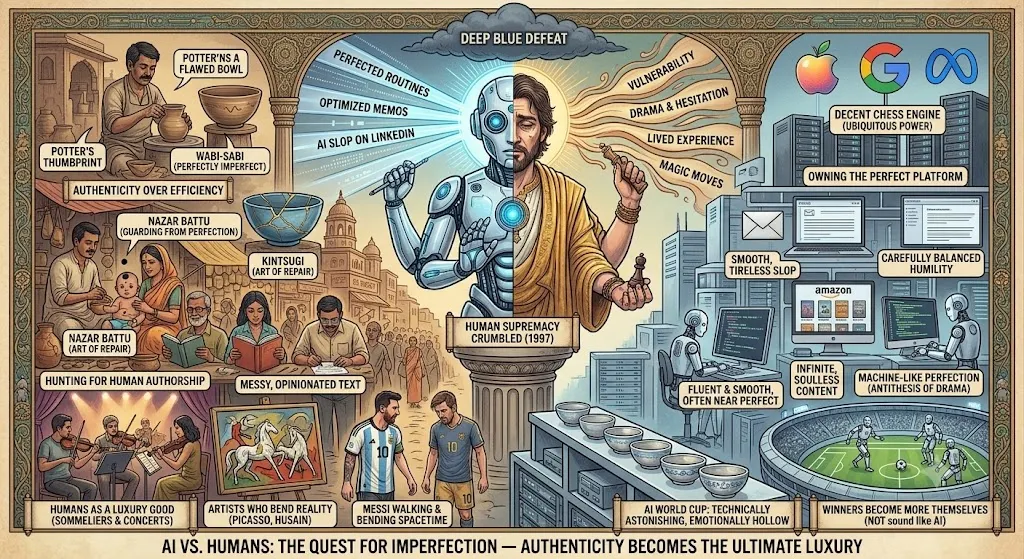
Bindra opens where the machine-versus-human story began. In 1997, Garry Kasparov lost to IBM’s Deep Blue, and, as he puts it, “our belief in human supremacy over machines took a big blow.” Chess — invented in India, refined across civilisations, treated as the highest theatre of pure human intelligence — had been conquered.
By every logic of the time, human chess should have withered. Instead it exploded. Today a chess engine on a mid-range phone would demolish any grandmaster alive; Magnus Carlsen and Praggnanandhaa will never out-calculate Stockfish. And yet more people watch them play than ever before.
Bindra’s explanation is the hinge of his whole argument: “the point of human chess was never only the perfect move.” We watch because two people like us hesitate, miscalculate, panic, improvise, tire — and then, out of nowhere, find a move that feels like magic. Two engines playing each other is technically superior and emotionally inert. What audiences want is drama, and drama is made of fallibility.
The Coming Fatigue With 10 Out of 10
The second pillar of Bindra’s POV is a prediction about taste. AI, he concedes freely, is already excellent. It writes clean LinkedIn posts, generates hummable songs, produces well-structured memos, builds McKinsey-grade slides and then summarises the lot in a competent email. It is “fluent, smooth, tireless, often near perfect; an almost 10 out of 10.”
His warning is that we will get sick of the 10 out of 10.
He points to what he calls the plague of AI slop on LinkedIn, and the pattern is instantly recognisable: the smooth opening line, the neat three lessons, the inspirational paragraph, the carefully calibrated humility, the “here’s what it taught me” close. Bindra’s verdict is brutal and precise — “grammatically correct and emotionally dead.”
The market response is already visible. Readers are actively hunting for the messy, opinionated, oddly structured, badly punctuated post that was unmistakably written by someone who lived that thought. The same correction is happening in publishing: with Amazon flooded by polished, soulless AI-generated titles, readers are treating a known publisher’s imprint as a proxy for human authorship. His formulation deserves quoting directly: “When text becomes infinite, real authorship becomes scarce.”
Imperfection as Provenance: The Potter’s Bowl
Bindra then widens the lens, and this is where his argument stops being about technology and becomes about culture. Humans, he notes, have always valued the mark of the hand. A machine can produce a perfect ceramic bowl — smooth, symmetrical, identical to the next thousand. We routinely pay more for the potter’s bowl precisely because it is not perfect. The uneven lip, the thumbprint, the slight tilt of the body: these are not defects. They are provenance. They signal that a human hand passed through here.
He grounds this in traditions that long predate AI:
- Wabi-sabi — the Japanese aesthetic of beauty in the impermanent, imperfect and incomplete, and its practice of kintsugi, mending a broken pot with gold lacquer so the fracture becomes the feature.
- Nazar battu — India’s instinctive equivalent: the black spot on a baby’s cheek, the deliberately ugly mask above a doorway. Perfect beauty feels dangerous, almost inhuman.
- The Persian carpet flaw — weavers were said to leave one deliberate imperfection, because perfection belonged only to God.
Across all three, the same insight: the flaw was never a failure. It was a signature.
Beauty Is Not the Same as Perfection
Bindra draws a distinction that anyone working with generative tools should internalise. AI will become extraordinarily good at beauty — symmetrical faces, flawless prose, balanced composition, correct answers. But beauty and perfection are not the same thing.
Picasso did not paint faces the way a passport camera sees faces. M.F. Husain’s horses were never anatomically correct; they were restless, elongated, full of motion. Their power came not from accuracy but from distortion. Real beauty, Bindra writes, lives “in the cracked note of a singer, the pause before an actor remembers a line, and the grandmother who never measured anything but always got the dish right.”
The Economics: Humans as a Luxury Good
Here Bindra brings in Sangeet Paul Choudary’s line that “in the age of AI, humans will become a luxury good.” The sommelier’s knowledge, selection and cork-sniffing performance carries a restaurant premium. A live concert commands a multiple over the identical Spotify track.
The mechanism is straightforward supply and demand. When machine output becomes abundant and cheap, human output becomes premium — not because it is more perfect, but because it carries unmistakable human presence and lived experience. This reframes human imperfection in the AI age from a sentimental idea into an economic one: scarcity is migrating from capability to authorship.
The Strategic Mistake Bindra Warns Against
His sharpest practical advice is a warning about positioning. The mistake humans will make in the AI age is to compete with machines on finish and polish — a race we lose by definition. “The worst thing a writer or artist can do now is try to sound like AI,” he writes, “sounding smooth, agreeable, optimised and dead.”
His prescription: the winners will be those who become more themselves, not less. Authenticity will always win over efficiency.
The Closing Image: A World Cup Without Nerves
Bindra ends where he began — with games. Picture a World Cup played by flawless AI robots. No misplaced passes, no bad tackles, no nerves, no exhaustion, no striker skying it from two yards. And no Messi walking for seventy minutes before suddenly bending spacetime.
It would be technically astonishing and emotionally hollow.
That image carries the entire thesis. In a world where machines generate perfection on demand, the most valuable thing a human being can do is remain unmistakably, recognisably imperfect.
Jaspreet Bindra’s Key Points at a Glance
- Chess proves the pattern. Machines conquered the game in 1997; human chess became more popular, because audiences want fallibility and drama, not optimal moves.
- We will tire of the 10 out of 10. AI output is near-perfect and increasingly indistinguishable — which is exactly why it will stop being interesting.
- AI slop is already triggering a correction. Readers are actively seeking messy, opinionated, human-marked writing over polished LinkedIn and Amazon output.
- Scarcity has shifted. “When text becomes infinite, real authorship becomes scarce.”
- Imperfection is provenance, not defect. Wabi-sabi, kintsugi, nazar battu and the Persian carpet flaw all encode the same truth across cultures.
- Beauty ≠ perfection. Picasso’s faces and Husain’s horses drew power from distortion, not accuracy.
- Humans are becoming a luxury good. Citing Sangeet Paul Choudary — abundance of machine output makes human presence premium.
- Don’t compete on polish. Trying to sound like AI is the single worst strategic move available to a creator.
- Authenticity beats efficiency. Become more yourself, not less.
What This Means for Anyone Building With AI
Bindra is not an AI sceptic — his read of the technology’s capability is generous, even bullish. His argument is about where value pools once capability is commoditised. If you are a writer, marketer, designer or founder, the practical translation is this: use AI for the parts of the work where perfection is genuinely the point — structure, research, first drafts, formatting. Reserve your own voice for the parts where the thumbprint is the product — the opinion, the anecdote, the argument you would defend in a room.
Embracing human imperfection in the AI age is not a rejection of the tools. It is the recognition that once everyone has the same tools, the only remaining differentiator is the one thing the tools cannot forge: that you were actually there.