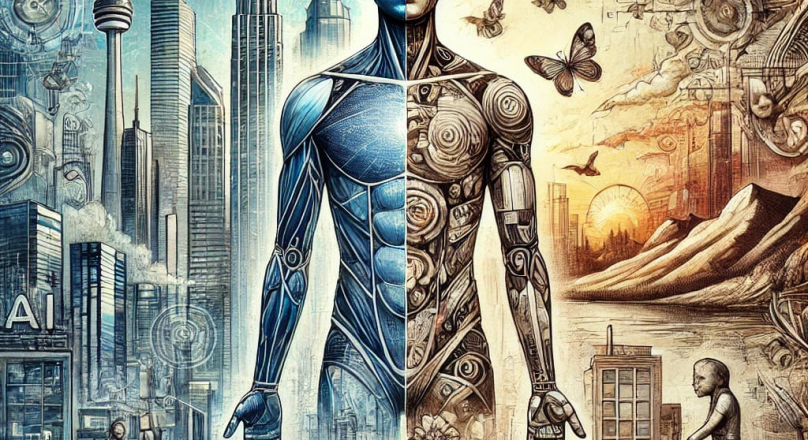
For thirty years the story of technology has been a story of closing the gap on human capability. Jaspreet Bindra, Cofounder of AI&Beyond, flips that story on its head. Writing in The Economic Times, he argues that human imperfection in the AI era is not a bug to be engineered away — it is the last credible signature of a human being. His thesis is deceptively simple: when machines can produce flawless output on demand, flawlessness stops being valuable. What becomes scarce, and therefore premium, is the visible mark of a person who actually lived the thought.
The Kasparov Paradox: Machines Won, Humans Got More Interesting
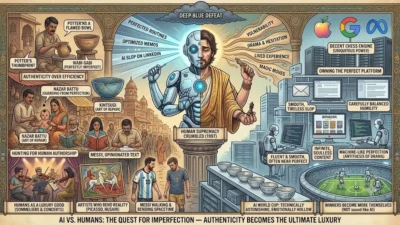
Bindra opens where most AI arguments end — 1997, Garry Kasparov losing to IBM’s Deep Blue. Chess, perfected in India and refined across civilisations, was long treated as the highest theatre of pure human intelligence. A machine took it. Today a phone-based engine beats any grandmaster alive, and no human will ever beat Stockfish again.
And yet chess is more popular than ever. Millions watch Magnus Carlsen and R Praggnanandhaa precisely because the point of human chess is not the perfect move. It is the vulnerability of two people who hesitate, miscalculate, panic, improvise, get tired — and then suddenly find a move that feels like magic. That is human drama. Two computers playing each other flawlessly leaves us cold. It is, in Bindra’s phrase, the very antithesis of drama.
This is the seed of his larger claim: the peculiar quest for imperfection may become the defining truth of the AI age.
Why We Are Getting Sick of the 10 Out of 10
AI can write a clean LinkedIn post, generate a hummable song, produce a perfectly structured memo, and finish a McKinsey-grade slide. It is fluent, smooth, tireless and near perfect — an almost 10 out of 10. Bindra’s warning is that we may soon become sick of the 10 out of 10.
He describes AI slop with uncomfortable accuracy, because most of us scroll past it daily: the smooth opening line, the neat three lessons, the inspirational paragraph, the carefully balanced humility, the “here’s what it taught me” ending. Grammatically correct. Emotionally dead.
The market response is already visible. Readers have started hunting for posts that are messy, opinionated, oddly structured, sometimes badly punctuated — but unmistakably written by someone who has lived that thought. In an environment of infinite polish, roughness reads as proof of life.
The Mark of the Hand
Bindra grounds this in something older than technology: humans have always paid for the mark of the hand. A machine can throw a perfect ceramic bowl, symmetrical and identical to the next thousand. We often pay more for the potter’s bowl precisely because it is not perfect — the uneven lip, the thumbprint, the slight tilt in the body. These are not defects. They are provenance. They signal that a human hand passed through.
The same shift is hitting publishing. Amazon is reportedly flooded with AI-generated titles — many polished, most soulless. The consequence is that readers increasingly seek books from known publishers rather than self-published ones, simply as a signal of human authorship. When text becomes infinite, real authorship becomes scarce. The value of a human book lies not just in how well it is written but in how clearly it has been felt.
Wabi-Sabi, Kintsugi and the Nazar Battu
Every culture that thought seriously about beauty arrived at the same conclusion. The Japanese call it wabi-sabi — the beauty of what is impermanent, imperfect and incomplete — and take it further in kintsugi, where a broken pot is mended with gold lacquer and the fracture becomes the feature. India has the nazar battu, the small black spot placed on a baby’s face or the fiercely ugly mask hung above a doorway, because perfect beauty feels dangerous, almost inhuman. Persian carpet makers were said to deliberately leave a flaw, since perfection belonged only to God.
The flaw was never failure. It was a human signature. That single line is the spine of Bindra’s argument about human imperfection in the AI era.
Great art understood this long before generative models existed. Picasso did not paint faces the way a camera sees faces. MF Husain did not draw horses the way horses look — his horses were restless, elongated, full of motion rather than anatomy, their power coming from distortion, not accuracy.
Beauty Is Not the Same as Perfection
Bindra draws a distinction the AI industry keeps collapsing. AI will become extremely good at beauty: symmetrical faces, flawless prose, balanced compositions, correct answers. But beauty is not perfection. Perfection lives in the cracked note of a singer, the pause before an actor remembers a line, the grandmother who never measured anything and always got the dish right.
This is why Sangeet Paul Choudary argues that in the age of AI, humans become “luxury goods.” We already pay a premium for a wine sommelier not for knowledge — a model has more — but for selection, cork-sniffing theatre, presence. We pay hugely more for a live concert than a Spotify stream. As machine output becomes abundant and cheap, human output becomes premium, not because it is better, but because it carries lived experience.
Authenticity Over Efficiency
The strategic takeaway is blunt. The mistake humans will make in the AI era is to compete with machines on finish and polish. The worst thing a writer or an artist can do is try to sound like AI — which is exactly what most of us are already doing on LinkedIn, optimising ourselves into smooth, agreeable, dead prose. The winners will be those who become more of themselves, not less. Authenticity will always beat efficiency.
Bindra closes where he began, with sport. Imagine a football World Cup played by perfect AI robots: no misplaced passes, no bad tackles, no nerves, no exhaustion, no striker missing from two yards, and no Messi bending space-time for seventy dormant minutes. Technically astonishing. Emotionally hollow.
The Bottom Line
In a world where machines can generate perfection on demand, the most valuable thing a human being can do is remain unmistakably, recognisably imperfect. Human imperfection in the AI era is not a deficiency to be optimised — it is the watermark that proves a person was here.
Meta Description (ready to paste)
Jaspreet Bindra argues human imperfection in the AI era is not failure but signature — why flawed, lived human output becomes premium as machines get perfect.
(158 characters, focus keyphrase embedded)
His Key Points — At a Glance
- The Kasparov paradox — machines conquered chess, yet human chess grew more popular. We watch for vulnerability, not accuracy.
- The 10/10 fatigue — AI output is fluent, tireless and near perfect, and we are already tiring of it.
- AI slop is recognisable — smooth opener, three neat lessons, balanced humility, “here’s what it taught me.” Grammatically correct, emotionally dead.
- Scarcity has flipped — when text becomes infinite, real authorship becomes scarce and valuable.
- The mark of the hand — we pay more for the potter’s imperfect bowl because the flaw signals provenance.
- Culture always knew — wabi-sabi, kintsugi, the nazar battu, the deliberate flaw in Persian carpets.
- Art always knew — Picasso’s faces, Husain’s horses: power from distortion, not anatomy.
- Beauty ≠ perfection — the cracked note, the actor’s pause, the grandmother who never measured.
- Humans as luxury goods (via Sangeet Paul Choudary) — sommeliers, live concerts: premium for presence, not accuracy.
- Authenticity over efficiency — don’t compete with machines on polish; become more of yourself.
- The robot World Cup test — perfect football would be technically astonishing and emotionally hollow.