
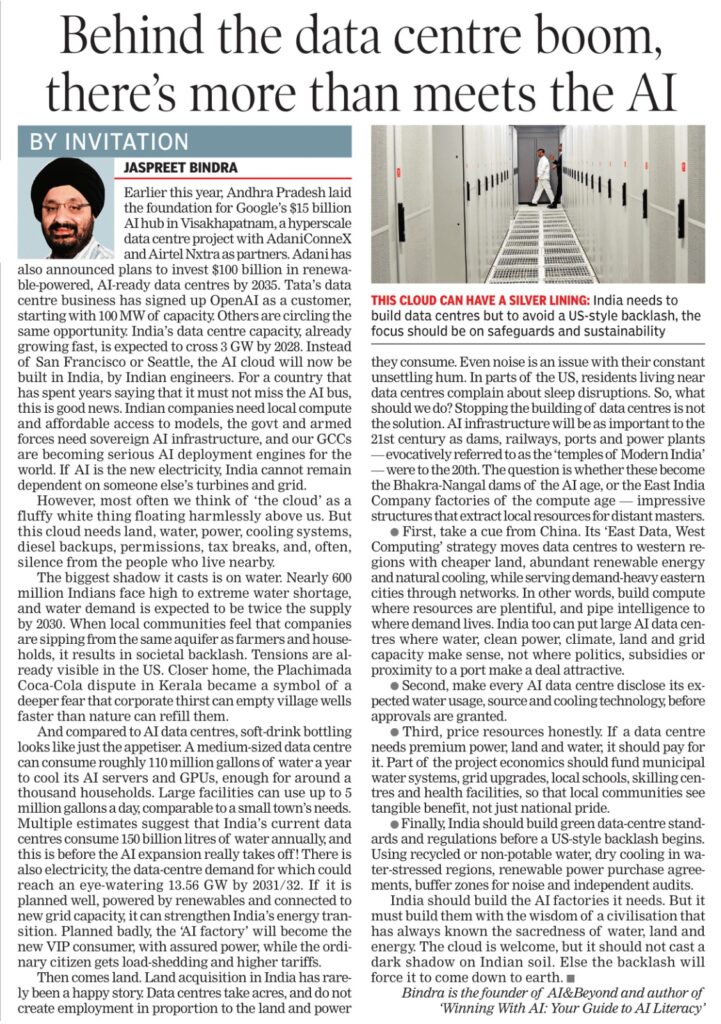
The AI data centre boom has become the defining infrastructure story of our decade, and few commentators have framed it as sharply as technology thinker Jaspreet Bindra. In his Times of India column, “Behind the data centre boom, there’s more than meets the AI,” Bindra argues that the real story of artificial intelligence is no longer being written in code and clever chatbots. It is being poured in concrete, strung across power grids, and measured in gigawatts and litres of water. To understand where AI is truly headed, he suggests, we have to look past the screen and into the physical world that quietly holds the entire revolution up.
The big idea: AI is an atoms problem, not just a bits problem
Bindra’s central point in the AI data centre boom debate is a deceptively simple reframing. For two decades, the technology industry trained us to think of progress as something weightless: software eating the world, apps in the cloud, intelligence delivered through a browser. Generative AI shattered that illusion. Every prompt, every generated image, every reasoning step from a large model draws on enormous, very physical resources. As Bindra has repeatedly put it, we are watching a movement from “bits to atoms,” where algorithms suddenly need vast quantities of land, electricity, cooling, and silicon to exist at all.
That is why he insists the AI data centre boom is best understood as the moment AI grew a body. The models may feel ethereal, but the data centres that run them are among the most resource-intensive structures humans have ever built. The headline numbers about model capabilities, in his view, distract from the harder, more consequential question: can we actually power and cool the machines that make those capabilities possible?
Energy is the real bottleneck
If there is one thread that runs through Bindra’s analysis of the AI data centre boom, it is energy. He frames electricity, not algorithms, as the binding constraint on how far and how fast AI can scale. A single hyperscale facility can demand as much power as a small city, and the global build-out is adding the equivalent of entire national grids in a matter of years.
This is where Bindra’s “atoms for algorithms” framing becomes vivid. He has highlighted how Big Tech has gone as far as reviving nuclear energy, signing deals to restart shuttered reactors and fund small modular reactors, simply to feed gigawatt-scale data centres. When the world’s most valuable companies start behaving like utilities and energy developers, he argues, it tells you that the centre of gravity in AI has shifted. The competitive edge is moving from who has the best model to who can secure reliable, affordable, low-carbon power at scale.
For Bindra, this carries a sobering implication: the AI data centre boom could collide directly with climate goals. If the surge in demand is met with fossil fuels, the carbon cost of intelligence becomes enormous. If it accelerates investment in clean and nuclear power, AI could paradoxically become a catalyst for the energy transition. Which path we take, he stresses, is a choice, not a foregone conclusion.
Water, land, and the hidden footprint
Bindra is careful not to let energy crowd out the other physical costs. Cooling those dense racks of chips consumes staggering volumes of water, and large facilities can draw hundreds of thousands of litres a day in regions that may already face scarcity. The AI data centre boom, in his telling, is also a water story and a land story, with real consequences for communities that host these campuses.
This is the “more than meets the AI” at the heart of his argument. Behind every seamless AI experience sits a supply chain of substations, transmission lines, chillers, water treatment, and rare materials. Most users never see it. Bindra’s contribution is to drag that hidden footprint into the conversation and ask who bears its costs and who reaps its benefits.
What it means for India
Bindra writes with a distinctly Indian lens, and the AI data centre boom raises urgent questions for the country. India is one of the fastest-growing data centre markets in the world, with capacity climbing steeply as cloud adoption and AI workloads accelerate. For Bindra, this is both an opportunity and a test. Done well, India could become a global hub for digital infrastructure, attracting capital, building skills, and asserting technological sovereignty rather than renting intelligence from abroad.
But he is clear-eyed about the trade-offs. India’s power grid, water stress, and land pressures mean the country cannot simply copy the Western build-out. The AI data centre boom forces hard policy choices about renewable energy, grid modernisation, water-efficient cooling, and where these campuses should be located. Bindra’s implicit challenge to policymakers is to treat data centre strategy as national infrastructure strategy, not as a niche IT concern.
From capability to consequence
A recurring theme in Bindra’s wider commentary is that AI is shifting from a story about capability to a story about consequence and judgment. The AI data centre boom is the physical expression of that shift. The question is no longer only “what can the model do?” but “what does it take to run it, and at what cost to the planet and society?”
This is why he resists pure techno-optimism and pure doom in equal measure. The infrastructure being laid today, he argues, will shape the economics, geopolitics, and environmental impact of AI for decades. Decisions made now about energy sourcing, location, and efficiency are effectively locking in the future. That makes the unglamorous work of grids, reactors, and cooling systems some of the most strategically important work in technology.
The takeaway
Jaspreet Bindra’s message about the AI data centre boom is ultimately a call to widen our gaze. The marvels of generative AI are real, but they rest on a foundation of atoms that is too easily ignored. Energy availability, clean power, water, land, and smart policy will determine whether this boom becomes a sustainable engine of progress or an environmental liability. The intelligence may be artificial, he reminds us, but its costs are very physical, and very real.
For business leaders, investors, and governments, the lesson is to stop treating infrastructure as an afterthought. In the AI data centre boom, the winners will be those who master atoms as confidently as they master algorithms.