

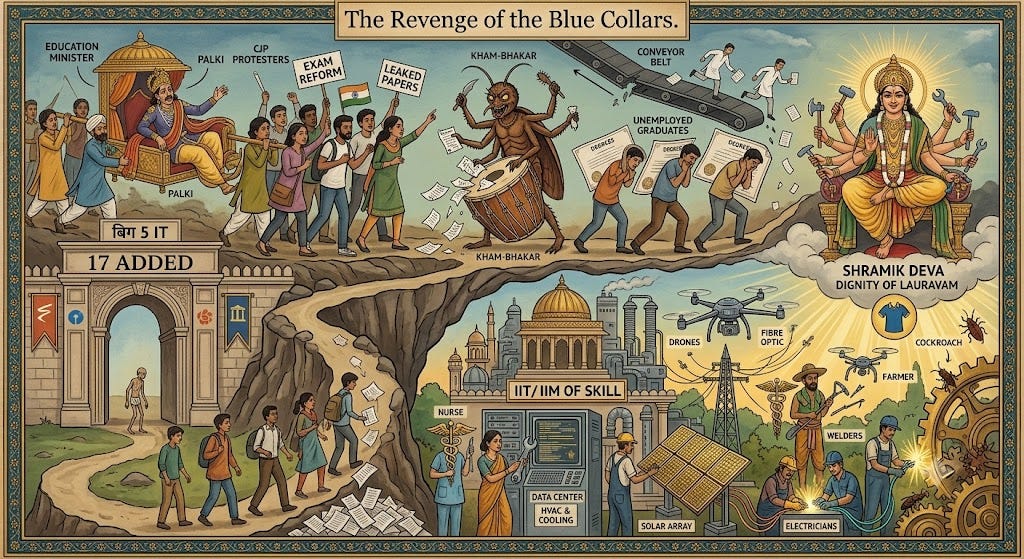
The conversation around AI and blue-collar jobs in India has just been turned on its head. In his essay The Revenge of the Blue Collars on Dharma of AI, technology thinker Jaspreet Bindra argues that the country’s youth unemployment anxiety — visible on the streets during the Cockroach Janta Party (CJP) protests — is not really about leaked exam papers at all. It is about a career bargain that no longer pays out. And his most counter-intuitive claim is this: the technology everyone fears as a job-killer may end up rehabilitating the very work India has spent decades looking down on.
Bindra opens not with an argument but with a number.
The number that frames the whole argument: 17
Seventeen. That, Bindra points out, is the net number of employees added by India’s five largest IT services companies — TCS, Infosys, Wipro, HCLTech and Tech Mahindra — during the first nine months of FY 2025–26. Not 17,000. Seventeen.
In the same nine-month window a year earlier, those five companies had added 17,764 people. For decades this was India’s most dependable employment machine, absorbing hundreds of thousands of engineering graduates every year. Bindra’s verdict: “that machine seems to be sputtering.”
He treats this single statistic as more explanatory than most of the commentary written about the protests.
His central POV: the protests were never only about exams
At the surface, Bindra concedes, the CJP protests were about leaked question papers, a compromised testing system, and the demand that the education minister resign. Those grievances were real, and the movement won — the minister resigned and examination reform was promised.
But peel back a layer, he writes, and something larger is visible. Young Indians are asking whether the old bargain still holds: study hard, clear ever-more-competitive exams, get a respectable degree, and a respectable job follows.
Bindra’s sharpest line captures the disquiet: “What happens when the examination is compromised, the degree devalued, and that kind of job no longer exists?”
He backs the mood with hard context. More than four in five unemployed Indians are under 30. Graduate unemployment runs many times higher than unemployment among those who cannot read or write. Real wages have stayed largely flat. Government skilling programmes, he notes bluntly, have produced certificates rather than employment.
The result is mass overqualification — engineers working as construction supervisors, postgraduates doing data entry, graduates absorbed into insecure gig work with no career ladder. “The anger over examinations,” Bindra writes, “is therefore also anger over what lies at the end of them.”
Why AI makes the anxiety sharper
This is where Bindra connects the protest to the technology story, and his point is specific rather than generic doom.
AI is not eating all work at once. It is eating the first rung — precisely the tasks handed to new entrants: making presentations, summarising documents, writing basic code, doing preliminary research, checking contracts, producing routine reports.
His insight is that those tasks were never just low-value output. They were the apprenticeship. They were how a 22-year-old watched seniors, made mistakes, learned how an organisation actually works, and slowly built judgment.
So the bottom rung of the white-collar ladder, in Bindra’s framing, is “not simply becoming harder to reach. In some professions, it is being removed.”
The casualty is a very recognisable Indian archetype: the 21-year-old engineer or 23-year-old MBA on the conveyor belt of school → engineering college → maybe an MBA → campus placement → management trainee → the long corporate climb. Or engineering → mass IT-services recruitment → a stack of certifications → a lifetime orbiting software.
That conveyor belt, he says, is breaking.
What he tells young Indians to do
Bindra offers four responses, and the fourth is the one that gives the essay its title.
- Build genuine AI literacy. Not prompt tricks — learning to work with these systems, interrogate their output, understand their limits, and use them to become more capable in a chosen field.
- Bet on humanities, judgment, context and domain knowledge. As routine answers become cheap to generate, the scarce skill is knowing which answer matters and why.
- Treat entrepreneurship as practical, not romantic. One or two people with AI can now build, market and run a business that once needed a much larger team.
- “Do what you were trained for.” This is his simplest and most disruptive advice.
For decades, Bindra observes, India took mechanical, civil and electrical engineers and converted them into software engineers. A mechanical engineer maintaining machines was considered less successful than one writing code at an IT firm. An electrical engineer working on power systems carried less prestige than someone making PowerPoint decks in consulting.
AI, he argues, may reverse that hierarchy.
The physical economy behind the AI economy
Bindra’s core structural argument on AI and blue-collar jobs in India is that the AI economy is not made only of models and software. It runs on concrete data centres, copper cabling, steel, transformers, cooling systems, renewable-energy installations and fibre networks.
All of which require electricians, HVAC technicians, welders, construction workers, maintenance engineers, solar technicians, equipment operators — people who build and repair things in the physical world.
“This may be AI’s most unexpected employment effect,” he writes. “A technology associated with replacing labour could help produce a renaissance of skilled blue-collar and grey-collar work.”
His policy ask: IITs for electricians
Bindra wants India to stop opening more engineering colleges whose graduates chase a shrinking pool of generic office jobs, and instead build IIT/IIM-calibre institutions for data centre electricians, robotic machinists, healthcare technicians, solar installers and drone operators.
His condition is non-negotiable: these must not be remedial institutions for those who “failed” academically. They must be aspirational — modern equipment, serious industry partnerships, real apprenticeships, credible employment pathways.
The dignity argument
Wages matter, Bindra says, but dignity matters just as much. India has long treated white-collar work as socially superior to work done with tools, machines, bodies or hands — a prejudice he traces partly to caste and feudal attitudes toward manual labour, and partly to post-liberalisation worship of engineering degrees, MBAs and “techie” office jobs.
His illustration is precise: a young person earning ₹5 lakh at an IT company is routinely seen as more successful than a shopkeeper, physiotherapist or pet-care professional earning twice as much. “We judge the colour of the collar,” he writes, “rather than the competence, usefulness or income.”
The closing idea: a classless crowd
Bindra ends by returning to the protest. What struck him about the CJP crowd was that it was not sorted by corporate designation, college pedigree, caste or collar colour. It was “something almost classless — a rough equality born from a shared fear about the future.”
That equality, he argues, must now extend to work itself. The electrician servicing an AI data centre is as much a technology worker as the programmer training the model. The technician, nurse, farmer, physiotherapist and welder are no less essential than the consultant, coder or manager.
India’s employment future, in his final formulation, may depend on accepting what its young protesters briefly demonstrated on the streets: blue-collar and white-collar work are different, but neither is inferior to the other.